
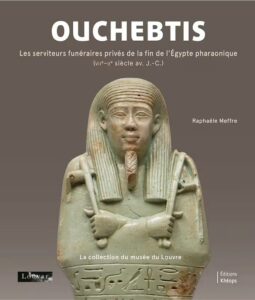
Name: Ouchebtis. Les serviteurs funéraires privés de la fin de l’Égypte pharaonique. (VIIe-IIe siècle av. J.-C.). La collection du musée du Louvre
Author: Raphaële Meffre
First published: 2026, Louvre
Amount of pages: 673
ISBN: 978-0-9566271-6-2
Average price: EUR 110
Availability: Good
Language: French
Content: Catalogue of the Late and Ptolemaic Period shabtis from the Louvre museum
Review: 
As a complete surprise to me came this monumental hard cover catalogue of the Late and Ptolemaic shabtis of the Louvre museum. In recent years the Louvre museum published its collection mostly online, so one could wonder what the benefit of having the same pieces in one book can be. Well, still a lot in my view.
The book describes and pictures thousands of shabtis and therefore represents the catalogue with the largest amount of late period shabtis ever published. Only examples for private indivuals are included, so, unfortunately, no royal shabtis can be found. Other then that the catalogue is very complete.
The set up of each entry is the same, in very small print some of the basic details like inventory number, condition and size. This is followed by a description in a regular print size, including a, limited, parallel overview. Of each object per owner all shabtis are published in smaller size colour pictures, scale 1:2 mostly with then at least one object in the actual size of the object, again in colour. The latter is similar to the catalogues produced by shabti scholar Glenn Janes which seem to have been a great source of inspiration for this catalogue. Apart from the similar set up (with the objects printed in actual size), also the parallel descriptions often refer to the excellent catalogues of Glenn Janes as the basis for reference.
Consequently, if the Louvre posseses for one owner 250 shabtis, they can all be found in this catalogue, front pictures then only, which is a fantastic source for further research.
The quality of the work is excellent. I have some reservations on the attribution of some 27-30th dynasty shabtis to the Ptolemaic period, but other then that the content is very professional and well done.
Conclusion
A specialist book for the researcher, antiquities dealer, collector and museum library. The commentary per object is very factual and therefore a bit limited for the wider audience. Unfortunately only available in French. Nevertheless, the content is so great and the workmanship is so excellent, that I recommend this book for any shabti enthousiast.